
BrowseComp: The Turing Test for the Next Generation of AI Agents
Today’s AI assistants excel at easy questions but falter on deep, multi-step investigations. OpenAI’s new benchmark, BrowseComp, was designed for this challenge and may define the future of advanced AI agents.
The AI assistants we use every day handle requests like “What’s the weather?” or “What is the capital of France?” with ease. But when a question becomes messy and demands detective-level persistence—piecing together evidence from a maze of sources—they tend to freeze. That is the current ceiling for autonomous AI agents.
OpenAI’s recent paper, “BrowseComp: A Simple Yet Challenging Benchmark for Browsing Agents,” confronts this gap head-on. It introduces BrowseComp, a benchmark built to measure whether an agent can stay focused, search deeply, and reason across the open web. It is not just a test; it sketches a new racetrack that separates mere “information retrievers” from true “problem solvers.”
What Is BrowseComp?
BrowseComp is a collection of 1,266 high-difficulty questions that all share one trait: the answers are extremely hard to find but easy to verify once discovered. The benchmark is not about how many facts an AI has memorized. It evaluates whether an agent, placed in an open-ended online environment, can show human-like patience, creativity, and logic when faced with a seemingly impossible puzzle.
You can explore more details in the project’s GitHub repository. BrowseComp’s design philosophy gives researchers a clear blueprint for evaluating and building more capable AI agents.
Reverse Questioning
BrowseComp’s difficulty comes from its unusual “reverse questioning” procedure. Instead of starting with a question and then searching for an answer, task creators flip the process on its head:
- Begin with a concrete fact (the “seed”). This can be a person, a paper, a competition, or any specific entity.
- Identify several traits that are hard to link directly to that fact. Each trait lives in a vast search space; none of them alone are enough to locate the answer quickly.
- Combine those traits into a single, multifaceted prompt.
The paper offers a great illustration:
Imagine the “seed” is a paper published at EMNLP. The author notices that the first author earned an undergraduate degree from Dartmouth College, while the fourth author completed their bachelor’s at the University of Pennsylvania. The resulting question becomes: “Which paper presented at EMNLP between 2018 and 2023 has a first author who graduated from Dartmouth College and a fourth author who graduated from the University of Pennsylvania?”
Brute-force search barely helps. You would need to scan thousands of papers over five years and examine the background of every author. Yet as soon as someone provides the answer—“Frequency Effects on Syntactic Rule Learning in Transformers”—a few quick searches are enough to confirm that it is correct.
This design keeps the tasks objective and demanding. It also offers a recipe for creating fresh, high-quality evaluation data.
An Information Maze That Stumps Humans
BrowseComp is not just difficult on paper. The authors invited human experts—people familiar with the domains but unaware of the answers—to tackle these problems. The results were sobering.
Under time constraints, human testers solved only 29.2% of the questions. Even when they succeeded, they often spent an hour or two of sustained digging.
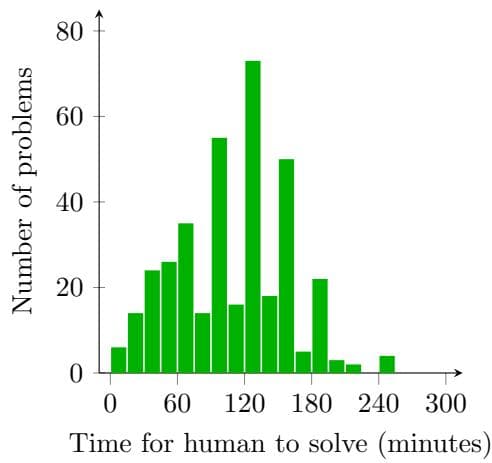
These problems require more than keyword matching. They demand cross-domain synthesis. One prompt might ask you to identify a 1990s soccer match but constrain your search by the referee’s nationality, the number and timing of yellow cards, the substitutions, and whether one substitution was injury-related.
This is not “search and answer.” It is an investigation. It rewards strategic thinking more than rote knowledge. That is BrowseComp’s biggest insight: the next generation of AI agents will compete on the depth of their planning and execution.
A Glimpse of the Future AI Race
The benchmark also hints at where the field is heading. Different AI systems, when evaluated on BrowseComp, showed wildly different results.
- General-purpose models such as GPT-4o, even with browsing enabled, achieved an accuracy of just 1.9%. Clearly, a simple “search-then-answer” pipeline breaks down in these scenarios.
- Deep Research—an agent built specifically for long-form investigation—did far better, solving 51.5% of the tasks. Its strengths lie in planning search paths, ranking sources, weaving together clues, and revising its plan as new evidence appears.
The authors also found a clear correlation between compute and performance. Giving the agent more time per attempt, or sampling multiple runs and voting on the best answer, led to sizable gains for Deep Research.
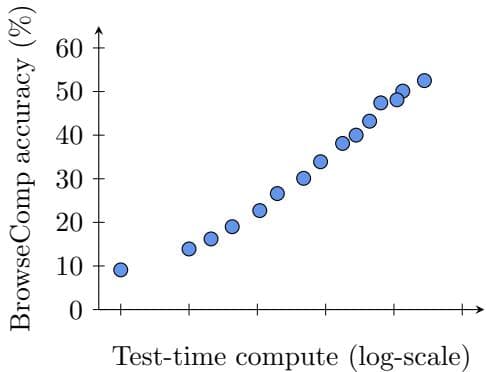
The message is clear: future agents will need stronger reasoning cores and more time and flexibility to think.
From Benchmark to Real-World Impact
BrowseComp’s value extends far beyond academic benchmarking. It opens practical doors for anyone building AI systems.
- For developers: BrowseComp is a golden standard for testing whether an agent can reason strategically and use tools effectively. The “reverse questioning” method also provides a template for crafting high-quality training data for complex, multi-step tasks.
- For product managers: An agent that can conquer BrowseComp could power entirely new product categories. Picture an assistant that automatically conducts competitive analysis, patent research, or financial due diligence.
- For everyday users: Tomorrow’s digital aides could become “problem-solving experts,” not just trivia bots. Tasks that currently take hours or days of manual digging might be offloaded entirely.
Conclusion
BrowseComp arrives at the perfect moment, offering clarity in a noisy, uncertain AI landscape. It reminds us that chasing bigger models and broader knowledge is not enough—we also need patience, strategy, and rigor in solving complex problems.
Seen in that light, BrowseComp is more than an exam. It is a Turing test for the next generation of agents. Any AI that can pass it has a real shot at becoming a trusted partner in our work and creativity.
Más artículos

STS: The Invisible Force Reshaping Product Visibility in the AI Search Era
An in-depth analysis of the paper 'Manipulating Large Language Models to Increase Product Visibility', revealing how Strategic Text Sequences (STS) manipulate AI recommendations and exploring the underlying technical principles, market implications, and governance approaches.


GEO: A New Paradigm for Visibility Optimization in Generative Engines
A deep dive into the GEO: Generative Engine Optimization paper and how creators can boost exposure in the age of generative search.

WebGPT: Teaching Language Models to Browse the Web for Themselves
Large language models are notorious for hallucinations—confident answers that are disconnected from reality. OpenAI’s WebGPT paper offers a solution: let the model search, read, and cite the web in real time to dramatically improve factual accuracy.