
WebGPT: Teaching Language Models to Browse the Web for Themselves
Large language models are notorious for hallucinations—confident answers that are disconnected from reality. OpenAI’s WebGPT paper offers a solution: let the model search, read, and cite the web in real time to dramatically improve factual accuracy.
Large language models (LLMs) are transforming how we access information, but their chronic “hallucination” problem—producing fluent yet false statements—remains a critical barrier to real-world adoption. A model can sound brilliant, but without factual grounding its value plummets. OpenAI’s WebGPT shows a pragmatic path forward. Rather than reinventing language generation, the researchers gave the model a skill humans rely on every day: using a browser to do research.
This article unpacks how WebGPT works. You can read the original paper at https://arxiv.org/abs/2112.09332. We will explore the methodology and highlight practical lessons for building AI systems that we can actually trust.
Using the Browser Like a Human
WebGPT’s central idea is deceptively simple. Instead of forcing the model to rely solely on its static internal knowledge—often outdated or incomplete—the team turns it into an active web researcher. To enable this, they created a text-only browsing environment.
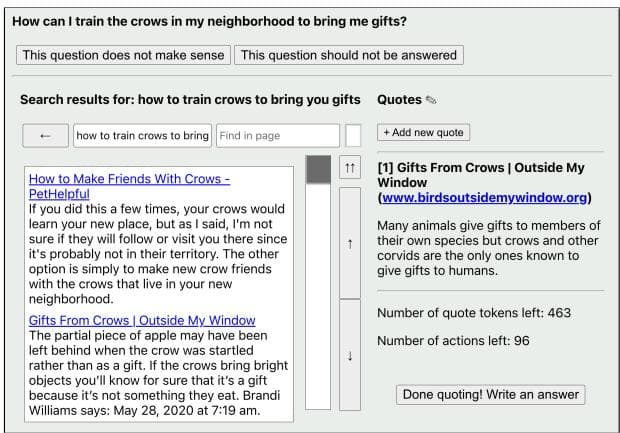
Inside this environment, the model is no longer passively generating prose. It executes a series of discrete commands that mimic how people browse webpages. These include:
Search <query>: Send a query to the Bing search engine.Clicked on link <link ID>: Open a specific link from the results page or the current page.Find in page: <text>: Search within the current page for keywords.Quote: <text>: Extract a passage that will later be cited in the answer.Scroll down/up: Navigate vertically within the page.End: Answer: Stop browsing and draft the final response using the collected citations.
Through this loop, the model shifts from a closed-book generator to an open-world investigator. It plans searches, filters sources, and gathers evidence to support its final answer.
How WebGPT Is Trained
Teaching a pretrained language model (GPT-3, in this case) to browse competently requires a carefully staged training pipeline. WebGPT combines several techniques so that, by the end, it outperforms the very humans who supplied the initial demonstrations.
Phase 1: Behavior Cloning
The model starts by learning the basics. Researchers recruited human contractors to answer questions in a graphical browsing interface. Every action—searching, clicking, quoting—was recorded to create an expert demonstration dataset.
The model then underwent supervised learning to imitate these experts. This behavior cloning (BC) phase trains the model to replicate human actions in context. The goal is to master the basic flow of browsing and evidence collection.
Phase 2: Optimizing for Human Preferences
Imitation alone only brings the model up to the average human level. To push beyond, WebGPT employs techniques inspired by Reinforcement Learning from Human Feedback (RLHF), centered around two components: a reward model and rejection sampling.
- Reward Modeling: The team had the model produce two different answers (with distinct browsing traces and citations) to the same question. Human evaluators then picked the better one. By collecting many such comparisons, they trained a reward model that predicts how highly a human would rate any given answer. This model learns to recognize factual accuracy, clarity, logical flow, and citation quality.
- Rejection Sampling: With a trained reward model in hand, quality control becomes straightforward. For a new question, the behavior-cloned model generates multiple candidate answers—say, 4, 16, or 64. The reward model scores each candidate, and the system outputs the highest-rated answer. This “best-of” strategy uses more compute at inference time but filters out weak responses, boosting factual reliability.
Following this two-stage process, WebGPT does more than use tools; it learns to use them well. In human evaluations, its answers beat the original human demonstrators 56% of the time and outperformed top-voted Reddit ELI5 responses 69% of the time.
Building Trustworthy AI Systems
Although WebGPT’s paper is a few years old, its lessons are sharply relevant for anyone building fact-sensitive applications today. Here are three actionable takeaways.
1. Treat Citations as First-Class Citizens
One of WebGPT’s biggest contributions is enforcing “answers must include citations.” This is not just about user trust—it is the key lever for measuring and improving factual accuracy.
Implementation idea: Whether you are building a question-answering system or a content generator, make provenance a core feature. RAG pipelines and more complex agent architectures alike should surface sources as they generate text. For an internal enterprise assistant, that means every answer links to the exact document, database entry, or wiki page it draws from. Citations build confidence and provide a scaffold for evaluation.
2. Adopt Multi-Step, Active Retrieval Strategies
Standard RAG systems typically run a single retrieval pass and feed the results to the language model. WebGPT demonstrates the power of iterative, adaptive search.
Implementation idea: Design a lightweight agent that mirrors WebGPT’s behavior. For complex questions, start with a broad search. Use the summarized results to decide whether to dive into a specific document (click), reformulate the query, or branch into a new line of inquiry. This iterative loop better reflects how human experts investigate, equipping your system to tackle harder problems.
3. Build a Human Feedback Flywheel
Behavior cloning supplies a solid foundation, but human preference optimization is what drives exceptional performance.
Implementation idea: Embed feedback hooks directly into your product—thumbs up/down buttons, or pairwise comparisons between two answers. Over time, aggregate this data to fine-tune a reward model and apply rejection sampling or more advanced RL techniques (such as DPO). Even without a massive labeling team, continuous, crowdsourced feedback nudges the model toward user expectations.
Conclusion
WebGPT demonstrates that solving hallucinations does not require a radical leap in model architecture. By pairing existing language models with mature external tools—like search engines—and building a feedback-driven optimization loop, we can create AI systems that are dramatically more trustworthy. It points toward a future where AI is not a sealed “black box” but an open, accountable partner that knows how to research and stand behind its answers.
更多文章

BrowseComp: The Turing Test for the Next Generation of AI Agents
Today’s AI assistants excel at easy questions but falter on deep, multi-step investigations. OpenAI’s new benchmark, BrowseComp, was designed for this challenge and may define the future of advanced AI agents.


STS: The Invisible Force Reshaping Product Visibility in the AI Search Era
An in-depth analysis of the paper 'Manipulating Large Language Models to Increase Product Visibility', revealing how Strategic Text Sequences (STS) manipulate AI recommendations and exploring the underlying technical principles, market implications, and governance approaches.

What Do We Gain When ChatGPT Replaces Google Search? Efficiency, Experience, and Hidden Traps
A study reveals the real-world gap between searching with ChatGPT and Google. ChatGPT delivers major efficiency gains and a better user experience, but falters on critical fact-checking tasks—offering hard lessons for how we should adopt next-generation information tools.